News
Latest news
(4/19/2012)
Stone Aerospace reveals Project VALKYRIE details
(4/19/2012)
Stone Aerospace wins Phase 2 funding for Project VALKYRIE
(5/19/2011)
ENDURANCE featured on National Geographic's Explorer Series
(3/24/2010)
ENDURANCE begins second season in Antarctica
(10/6/2009)
NASA Approves ENDURANCE Upgrade Funding
(6/5/2009)
ENDURANCE Antarctica Mission begins
(11/26/2008)
Zacaton mission 3 begins
(5/13/2007)
Zacaton mission 2 begins
(3/07/2007)
Zacaton mission 1 begins
(1/26/2007)
Stone Aerospace Hawaii
(1/12/2007)
Joint Venture with New Vistas International
(1/05/2007)
Stone Advocates Lunar Mining
(1/01/2007)
2008 J2 Expedition Training Agreement
(8/27/2006)
Stone Seminar at Google
(8/27/2006)
DEPTHX takes flight
(7/26/2006)
MK6 design contract signed
(12/9/2005)
Zacaton Drop Sonde Mission
(5/29/2005)
ARMADILLO WORKS – Austin HQ up and running
(2/01/2005)
About us
Products
Contact


Home | Contact

Fat Man underwater propulsion vehicle ENDURANCE lands at Lake Bonney, Antarctica
Variable depth underwater habitat DEPTHX testing at the Applied Research Lab at UT
Bill Stone reads a paperback while spending 24 hours underwater using the MK1 rebreather Map of Wakulla Springs created using the Digital Wall Mapper MK1 rebreather
News: Stone provides seminar on Deep Cave Exploration and Planetary Life Exploration to Google at Google Headquarters

27 August 2006:

Watch a video about the seminar.

Autonomous Exploration of the Sub-Surface Ocean of Europa
William C. Stone, Ph.D., P.E.
August 27th , 2006
Google HQ

ABSTRACT

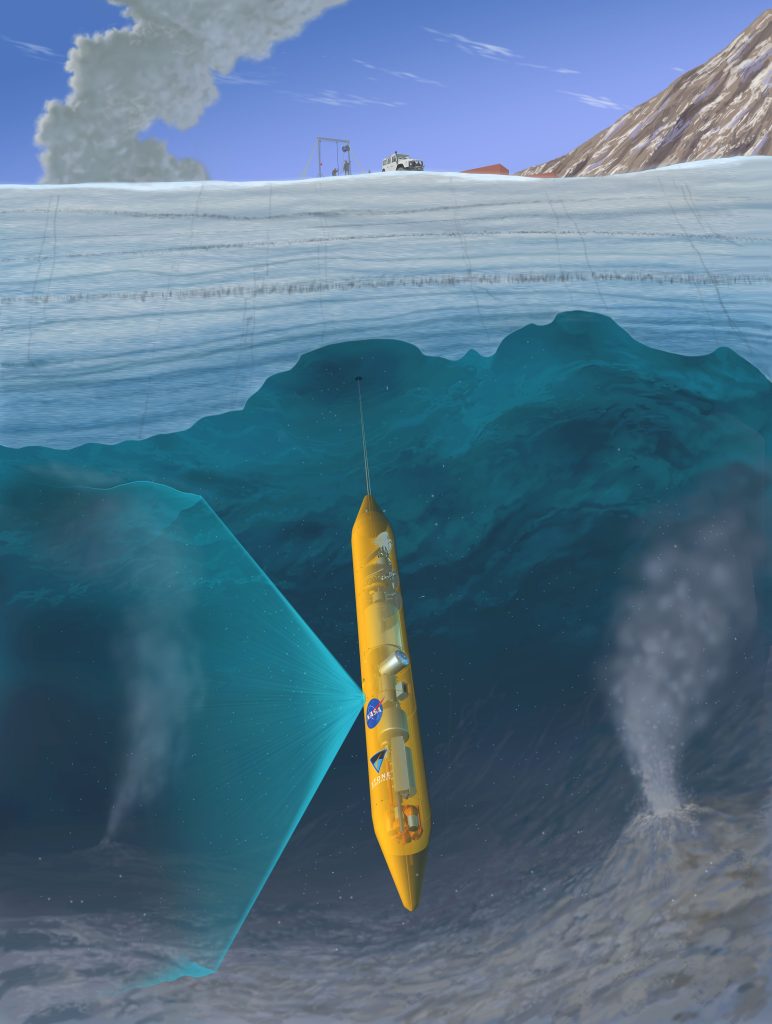
The NASA Deep Phreatic Thermal Explorer (DEPTHX) project is developing a fully autonomous underwater vehicle intended as a prototype of the Europa lander third stage that will search for microbial life beneath the ice cap of that Jovian moon.

DEPTHX has two principal objectives: First, to develop and test in an appropriate environment the ability for an un-tethered robot to explore into unknown 3D territory, to make a map of what it sees, and to use that map to return home; and second, to demonstrate that silicon intelligence can identify likely zones for the existence of microbial life, to command an autonomous maneuvering platform to move to those locations, conduct localized searches, and to autonomously collect microbial life in an aqueous environment.

The concept and prototypes will be tested in an unusual terrestrial analog that presents many of the likely morphologic regimes where life may exist on Europa, including irregular vertical surfaces, an open water column, floor sediments, and potential hydrothermal vents: the 300-meter-deep (or more) hydrothermal cenote of Zacatón, Mexico, which contains diverse microbial mats, but remains uncharted, both spatially and biologically. The site offers an extraordinary opportunity to test the principles and hardware under development.

In this presentation Dr. Stone will summarize the overall vehicle architecture and control systems approach to autonomous exploration in fully 3D environments in which apriori knowledge of the environment is non-extant and for which there exists no external navigation system. The latest field work at the Zacaton cenote using a drop sonde variant of the DEPTHX vehicle core navigation components will be presented along with the current state of development of the vehicle which, if fully successful, will represent a dramatic leap forward in mobile robotics.